



The point
When the shopper delegates the comparison work to an AI assistant, the retailer's optimisation surface area shrinks from "rank, click, convert" to "be in the data the assistant trusts." Six factors decide whether your product gets cited.
A customer opens ChatGPT and types: "what's the best trail running shoe under $150." Three named products come back, with reasoning. The customer asks one follow-up question, gets a single recommendation, clicks the link, and buys.
The retailer that won the sale never appeared in a Google search result for that query. They were not optimised for the shopper's keyword, did not bid on it, did not show up in any SERP the customer ever saw. They were selected by the assistant. Selected for reasons that almost no e-commerce team has yet bothered to understand.
This is agentic commerce. The structural shift it represents is larger than mobile, larger than social commerce, and is happening on a faster timeline than either. Most store owners I speak with are aware that AI is changing how shoppers find products. Almost none have changed anything in their operations because the playbook is not yet written down.
This article writes part of it. What agentic commerce is, which assistants are doing it now, what signals they use to pick products, and the three actions every store owner can take in the next 90 days to be selectable when a competitor is not.
What is agentic commerce?
Agentic commerce is purchase activity where an AI assistant evaluates products for the shopper, recommends a short list, and increasingly transacts on their behalf.
The shopper delegates the comparison work to an assistant. The assistant queries multiple data sources at once: product feeds, structured data on retailer sites, aggregated reviews, editorial content, third-party comparison platforms. It ranks the options against the shopper's stated criteria, returns two to four named products, and frequently links directly to checkout. In a growing share of cases, the assistant initiates the transaction itself through integrated checkout APIs.
Three things change for the retailer in this model. The algorithm doing the picking is different from the search engine algorithms most stores have spent a decade optimising for. The data sources the assistant pulls from are different and broader than what any single platform indexes. And the surface area for influencing the outcome shrank from "rank, click, convert" to "be in the data the assistant trusts." Optimisation moved upstream. The retailer who understands the new inputs has a structural advantage that compounds.
How does agentic commerce differ from traditional ecommerce?
The traditional ecommerce flow is well understood. A shopper has a need. They search Google or Amazon. A SERP returns ten results. The shopper evaluates them, clicks through to two or three sites, compares offers, and buys. Three of those steps belonged to the retailer: ranking, the click, the conversion. The comparison work belonged to the shopper.
The agentic flow rearranges almost all of it. The shopper still has a need. They ask an assistant in natural language. The assistant evaluates products across multiple data sources without the shopper ever seeing a SERP. It returns two to four recommendations with reasoning. The shopper trusts the answer or asks a follow-up. Increasingly, the assistant transacts directly.
The shopper's role shrank. The assistant's role grew. The retailer's surface area to influence the decision shrank with it. You used to compete with whoever ranked above you in the SERP. You now compete with whoever the assistant cites. A small store with clean structured data, complete product feeds, and consistent third-party validation can be cited over a large store with weaker data, even if the large store dominates traditional SEO.
The economic implication is significant. Traditional SEO and SEM rewarded scale and budget. Agentic commerce rewards data quality and credibility across the web. Those are different inputs, with different cost structures and different competitive dynamics. A category leader on traditional search can be a category laggard in agentic commerce, and vice versa, on a much shorter timeline than most teams expect.
Which AI assistants pick products today?
Five matter right now.
ChatGPT Shopping launched in late 2024 as a beta inside ChatGPT and has expanded steadily through 2025 and into 2026. It pulls product data from a combination of merchant feeds, public web sources, and partner integrations. When a user asks for a product recommendation, ChatGPT returns named products with descriptions, prices, and links. Roughly 800 million weekly active users see this surface.
Perplexity Shopping launched in November 2024 and has positioned product search as a core use case rather than a feature add. It pulls heavily from structured data, third-party reviews, and editorial content. Smaller user base than ChatGPT, but high purchase intent and strong influence in categories where shoppers research carefully before buying.
Google AI Mode and AI Overviews began surfacing product information inside AI-generated answers in 2025. The data sources are the Merchant Center catalog, organic search results, and structured data on retailer sites. This shift is the most consequential of the five because Google still controls the largest discovery surface, and AI Overviews are intercepting queries that previously went to standard SERP results, compressing organic traffic to retailers across the board.
Gemini Shopping is Google's standalone assistant integration with Merchant Center and the Shopping graph. Less mature than ChatGPT or Perplexity for discovery today, but its reach inside Android and Google Workspace makes it strategically important on a two-year horizon.
Amazon Rufus is a closed system that only recommends products from Amazon's own catalog. If you sell on Amazon, Rufus is its own discipline. If you do not, it does not apply directly, but it is training shoppers to expect AI-mediated discovery everywhere else, which changes their behaviour on your site.
How do AI assistants pick which products to recommend?
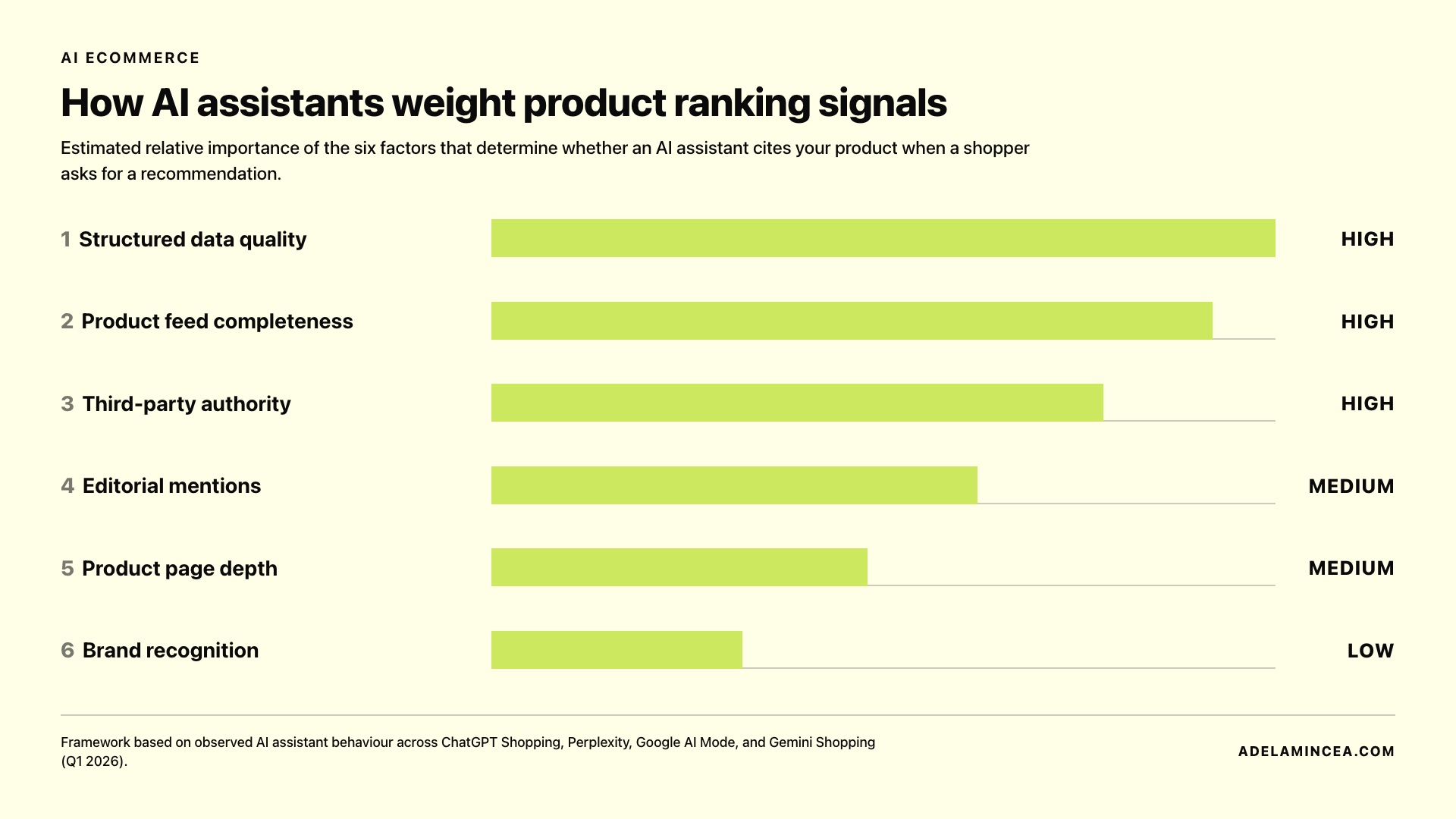
Six factors decide whether your product gets cited.
1. Structured data quality. AI assistants read structured data first because it is unambiguous. Schema.org Product markup, accurate GTINs, brand identifiers, current price, and live availability give the assistant a reliable record to work with. Missing or stale structured data does not only hurt rankings, it makes the product invisible. Assistants prefer products they can describe accurately. If your data is incomplete, they describe a competitor instead.
2. Product feed completeness. For Google AI Mode and Gemini in particular, the Merchant Center feed is the source of truth. Missing attributes like color, material, size, certifications, or compliance information reduce the chances of being matched to a specific shopper query. Feed quality is the highest-leverage technical fix available to most stores. A complete feed gets considered. A 60 percent complete feed gets considered roughly 60 percent of the time.
3. Third-party authority. The assistant cross-references products against external signals. Aggregated review scores from independent sites, mentions in publications, ratings on comparison platforms. A product with consistent third-party validation gets cited more often than a product with only first-party marketing claims. The question the assistant is effectively asking: "does the rest of the web confirm this is a credible product?"
4. Editorial mentions in publications AI trusts. Assistants weight content from sources they treat as authoritative. Wirecutter, Consumer Reports, vertical specialists like Outdoor Gear Lab in their categories, established review sites. A product mentioned in those sources accrues citation weight that the brand cannot generate alone. This is the AI version of digital PR, and it compounds. Once a product is in three or four trusted reviews, it gets recommended consistently across multiple assistants at once.
5. Product page content depth. The assistant reads your product pages. Specifications, materials, dimensions, use cases, FAQs, comparisons. Pages with depth give the assistant more to match against the shopper's specific query. Pages that are eighty words of marketing copy and a buy button give it nothing. The product pages that win in agentic commerce read like a structured knowledge base, not a brochure.
6. Brand recognition signal. This is the slowest-moving factor and the hardest to influence in the short term. Assistants weight brands they have seen mentioned consistently across many sources. A brand that appears in editorial content, structured data, third-party reviews, and merchant feeds together accumulates a recognition signal that materially increases citation probability. New brands can compete, but only by being conspicuously present in every other layer.
The pattern across all six is the same. The assistant trusts signals that are consistent and verifiable. It distrusts marketing claims that exist only on the brand's own site. The economic consequence is that the work of being recommended by AI is mostly the work of being credible across the web, not the work of optimising one channel.
Most stores fail on the first three factors before ever reaching the strategic ones. The audit checks all six against your top SKUs.
See what the audit covers →What should store owners do now?
Three actions, in order of leverage.
1. Audit your structured data. Most stores have partial Schema.org markup that breaks under inspection. Test every product page with Google's Rich Results test. Confirm GTINs are present, prices update in real time, availability reflects actual stock, brand and aggregateRating fields are populated where applicable. Fix gaps in the catalog template, not page by page. This is a one-time engineering job that pays compounding returns. The pattern across e-commerce stores I work with is consistent: structured data is partial, often broken on a meaningful share of SKUs, and almost never audited end to end.
2. Get products mentioned in third-party content. Identify the publications, review sites, and comparison platforms in your category. Most have either an editorial pitching process or an affiliate program. Both work for AI citation purposes because the assistant does not distinguish editorial from affiliate at the citation layer. The goal is to be present in three to five trusted external sources per product line. This is a quarterly content and PR effort, not a one-off campaign, and the citation weight builds with consistency over twelve to eighteen months.
3. Make product feeds AI-readable. Your Merchant Center feed almost certainly has missing attributes. Material, color, size variants, certifications, target audience, age groups, gender, condition. Audit the feed against the full attribute list for your category. Fix the gaps systematically. A complete feed is no longer a nice-to-have. It is the entry ticket to Google AI Mode and Gemini Shopping, and increasingly the data ChatGPT and Perplexity cross-reference when they verify product claims. The work is unglamorous and high leverage, which describes most of the operational improvements that actually move revenue.
These three actions are not optional. They are the minimum required to be in the consideration set when an assistant evaluates your category. Skip them and your product simply is not visible, regardless of how good the product is or how much you spend on traditional acquisition channels.
Why act now?
The window is real, and it is short. Roughly 95 percent of e-commerce stores have not addressed agentic commerce in any structured way. Most have not audited their structured data in years. Their product feeds have known gaps that have been ignored for budget reasons. They have no editorial presence outside their own marketing channels and no plan to build one.
This is the same condition that existed in early Google SEO in 2003, in early Facebook ads in 2010, and in the first wave of influencer marketing in 2015. A small number of operators that did the unglamorous foundation work captured a disproportionate share of the channel before it became competitive. The cost of doing it later, after the channel matures, is always higher than the cost of doing it now, when the bar to be visible is still low.
Organic search traffic to retailer sites is already declining as AI assistants intercept queries that previously triggered ten blue links. The question is no longer whether AI-mediated commerce becomes the dominant discovery surface. It is which retailers are visible inside it when it does.
Where to start
If you want a clear assessment of how your catalog and product data hold up against the way AI assistants are evaluating products today, the AI-Ready Catalog Audit walks through structured data completeness, Merchant Center feed health, third-party citation footprint, and product page depth across your top SKUs. One delivery, $599, no retainer.
This article is based on patterns observed across e-commerce accounts I work with in the $50K to $5M annual revenue range. The structural recommendations apply across that scale. The implementation effort scales with catalog size, but the diagnostic does not.
Adela Mincea is a marketing economist, paid media strategist, and certified trainer. She helps growing businesses make marketing profitable before scaling it by validating margins, acquisition economics, and pricing power before deploying paid media and AI-enabled systems.

Adela Mincea
Marketing Economist
The Marketing Economist
One concept from economics. One marketing decision it changes.
One issue per month. Each one takes an economic concept and applies it to a real marketing decision, the kind that affects budget, margin, or growth.