

Your Shopping budget is reaching the wrong buyers. Find out why.
A structured feed audit that finds exactly where your product data is misdirecting spend, and a prioritized roadmap to fix it. Delivered in 5–7 days.
0+
Years in paid media and ecommerce
0
Feed audit categories
100+
SKUs minimum
5–7 days
Delivery
What is product feed optimization?
Product feed optimization (also called product feed management) is the process of improving the structured data sent from an e-commerce store to Google Shopping, to ensure products appear in the right searches and reach buyers with intent to purchase. It covers title construction, attribute completeness, category taxonomy, and feed error resolution, the factors that determine which queries trigger your ads, at what cost, and with what conversion rate.
You're spending on Shopping. The wrong people are clicking.
What e-commerce teams say when Shopping spend isn't matching the returns.
The campaign is running. The feed is pointing it at the wrong buyers.
Shopping campaign performance is largely determined before a single bid is placed. The feed tells Google what your products are, who they're for, and when to show them. If that data is wrong, no amount of bid optimization fixes it.
Shopping ads spend on clicks that will never buy.
When product titles don't match buyer search language, Google shows your products for searches with no purchase intent. You pay for every click regardless of whether the person was ever going to buy.
The feed is the campaign. Most teams don't treat it that way.
Bid strategy and campaign structure get the attention. The feed, which determines which searches trigger your ads, is often set up once and not touched. The feed is doing more to determine your Shopping results than the campaigns are.
Automation makes a bad feed worse.
PMax distributes budget based on what the feed tells it about your products. A weak feed gives it bad signal, and it scales that. In 2026 Google extended this further: AI Max for Shopping and AI-powered Shopping ads also build directly on your feed data. The feed now drives more of your results than ever, and more budget on a feed problem just produces more of the same problem.
Right fit. Wrong fit.
This is for you if
- ✓Running Google Shopping or Performance Max campaigns
- ✓100+ SKUs in an active product feed
- ✓Shopping spend is inconsistent or underperforming
- ✓You have suppressed or disapproved products
- ✓You want to scale Shopping spend but want the feed sorted first
Not for you if
- ✕No active Shopping or PMax campaigns
- ✕Under 100 SKUs or no Merchant Center account
- ✕Looking for full feed management on an ongoing basis
- ✕Need a feed built from scratch, this is an optimization, not a build
Not a Merchant Center checklist.
vs. campaign optimisation alone
Bid and budget changes operate on top of the feed. If the feed is sending the wrong data, no amount of campaign work fixes it. This audit treats the feed as the primary lever, not an afterthought.
vs. automated feed tools
Feed management tools apply rules at scale. They don't evaluate whether your titles match buyer intent, whether your taxonomy is suppressing visibility, or whether your feed structure is limiting what PMax can learn from.
vs. fixing it yourself
Most feed fixes are made by changing what's easy to change, descriptions, a few titles. The structural issues that drive most wasted spend, taxonomy, attribute completeness, intent mismatch, aren't visible without a systematic review.
Six categories. Every gap that's costing you spend.
Structured feed review covering data quality, intent match, taxonomy, suppressed products, and Shopping algorithm signals. Every finding ranked by spend impact.
Delivered in 5–7 business days. If you don't find at least 3 things worth acting on, full refund, no questions asked.

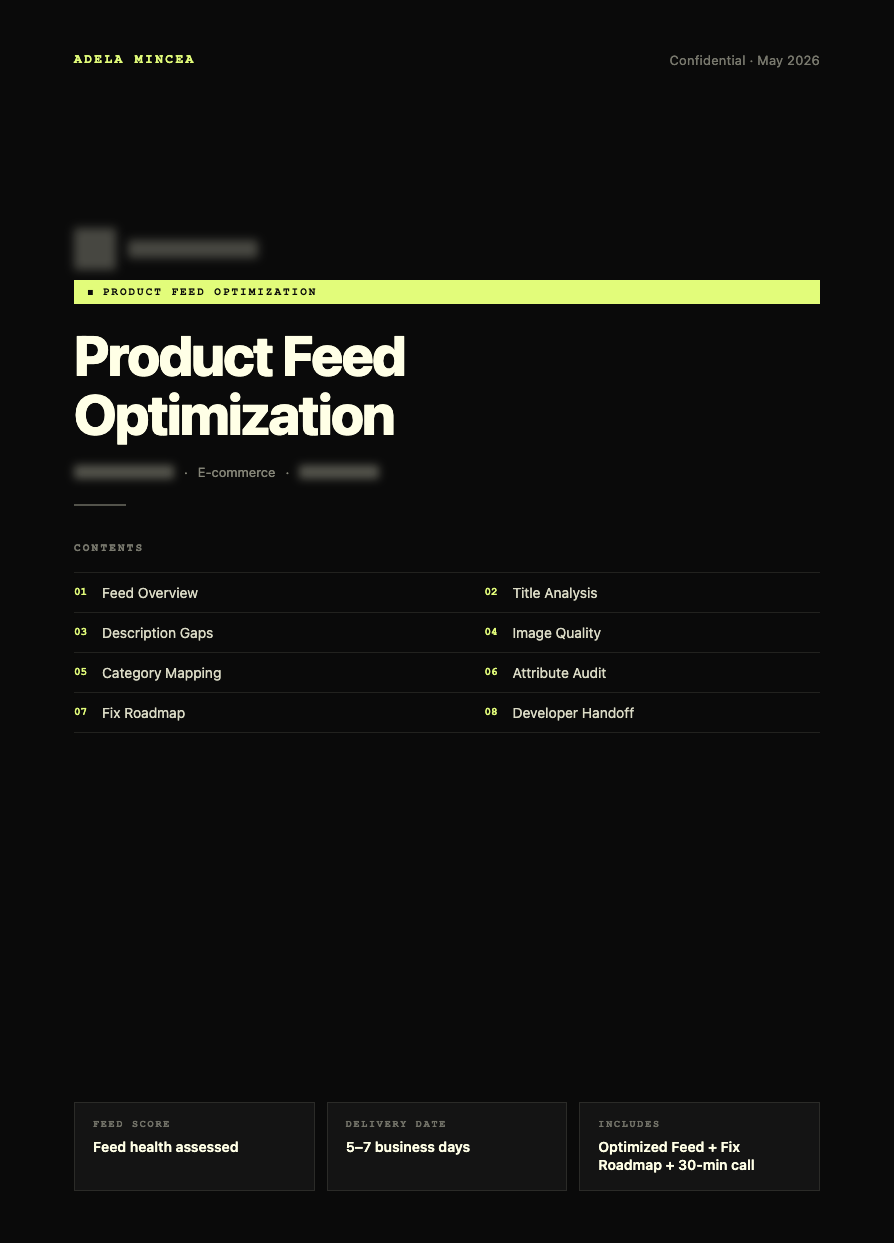
Product Feed Optimization
You go from not knowing why Shopping is underperforming to having a ranked fix list, what to change in the feed, in what order, and what that change does to spend efficiency.
What a finding looks like
74% of product titles lead with brand name. Buyers searching this category use material, size, and use-case as primary qualifiers, not brand. The titles are optimized for brand recognition, not search match. Consequence: appearing for branded searches that convert poorly while missing high-intent category searches.
Fix
Restructure titles to: [Material] + [Product Type] + [Key Attribute] + [Brand]. Apply to the top 40 SKUs by spend first. Estimated improvement in category search visibility: 30–40%.
Example from a real audit. Details anonymized.
How your product data is organized, titles, descriptions, attributes, and taxonomy. Scored against Google's requirements and Shopping algorithm signals.
You work directly with me. Not a team, not a junior.

Adela Mincea
Marketing Economist
I work with e-commerce businesses that run Shopping campaigns but can't see the return in the numbers. 13+ years across Dubai, London, and Hong Kong, finding the gap between what the feed signals and what the campaign is producing.
- Google Ads certified with deep Shopping and PMax specialization
- Commercial economics background, feed fixes connected to revenue impact, not just platform metrics
- Product catalogs from 100 to 50,000+ SKUs
- Shopping, PMax, and CSS campaigns across multiple markets
- Merchant Center troubleshooting and feed architecture
- Product feed structure and title optimization
- Shopping intent matching and taxonomy
- Merchant Center health and suppression recovery
- PMax feed signal and automation review
Simple process. Clear output. No back-and-forth.
You share feed access
Merchant Center read access and your current feed. I'll confirm what's needed when you submit.
Confirm scope and payment
Payment link sent within 24 hours. Work starts on confirmation.
Feed review and analysis
Full audit across feed structure, intent match, taxonomy, and suppression. Every finding verified manually.
You get the report
Scored findings with prioritized fix roadmap in 5–7 business days.
You share feed access
Merchant Center read access and your current feed. I'll confirm what's needed when you submit.
Confirm scope and payment
Payment link sent within 24 hours. Work starts on confirmation.
Feed review and analysis
Full audit across feed structure, intent match, taxonomy, and suppression. Every finding verified manually.
You get the report
Scored findings with prioritized fix roadmap in 5–7 business days.
Choose the level of support you need.
Lite
The full feed audit delivered as a scored report with fix roadmap.
- ✓Feed structure audit
- ✓Title & attribute analysis
- ✓Taxonomy & category mapping
- ✓Suppressed product recovery list
- ✓Search term to product match review
- ✓Prioritized fix roadmap
- ✓Delivered in 5–7 business days
Standard
The audit plus a 30-minute walkthrough to go through findings and next steps.
- ✓Everything in Lite
- ✓30-minute walkthrough call
- ✓Live Q&A on findings
- ✓Prioritized action plan for your team
- ✓Recording of the call
Full
The audit plus hands-on implementation of the top 3 feed fixes identified.
- ✓Everything in Standard
- ✓Implementation of top 3 feed fixes
- ✓Title rewrites for top-spend SKUs
- ✓Taxonomy corrections applied
- ✓30-day follow-up check
All prices in USD. One-time payment. No retainer, no surprises.
Common questions.
Read-only access to Google Merchant Center and your product feed file (Google Sheets, XML, or direct feed URL). If you're running PMax, Google Ads read access is helpful. I'll confirm when you submit.
Google Sheets feeds, XML feeds, and feeds managed through third-party platforms (Shopify, WooCommerce, Channable, DataFeedWatch, etc.).
Yes. The audit evaluates the feed output, what Google actually receives, not how it's generated. Developer-built feeds often have structural issues that aren't visible without a content review.
More than before. Automation doesn't fix a weak feed, it scales it. In 2026 Google extended this further: AI Max for Shopping and AI-powered Shopping ads both build directly on your product feed data. The stronger the feed, the better the signal every automated system has to work with. The feed is the one input you still fully control.
100 SKUs for meaningful analysis. If you have fewer, contact me first to discuss whether a lighter scope makes sense for your catalog size.
If you don't find at least 3 things worth acting on, full refund, no questions asked.
Yes. Product feed optimization and product feed management are often used interchangeably. Both refer to structuring and improving your product data so it performs well in Google Shopping and other comparison channels. This engagement covers that work: title construction, attribute quality, category mapping, and error resolution. The output is an optimized feed and audit report.
Your feed is deciding where your Shopping budget goes. Let's find out what it's deciding.
Share your feed details below. I'll review and send a payment link within 24 hours.
Your details
Not ready to buy yet? Get the monthly newsletter instead →