



The point
A client's ROAS climbed to 4.1x over twelve months. Gross margin was flat for eleven of them. The platform said the account was working. The P&L said something different. That distance is exactly what a marketing economist is paid to explain.
A client sent me their Google Ads report last year. Twelve months of data. ROAS at 4.1x. CPC down 18% year on year. Every metric pointing in the right direction.
Then I looked at their gross margin data. Flat for eleven months, despite revenue growing 34%.
The platform said the account was working. The P&L said something different. The distance between those two numbers is exactly what a marketing economist is paid to explain.
A definition
A marketing economist is someone who applies economic analysis to marketing decisions.
Not marketing theory. Not campaign management. Economics: the study of how resources are allocated, how incentives work, and what decisions cost relative to what they return.
In practice, a marketing economist reads your acquisition model the way a CFO reads a P&L. Not "which campaigns are performing?" but "what is acquisition actually costing, by channel, by cohort, and does the model support what we're about to do with the budget?"
The working definition: a marketing economist connects marketing activity to commercial outcomes using the tools of economic analysis. The job is the translation layer between what the marketing dashboard shows and what the finance function needs to know.
Marketing economist vs. marketing specialist
A marketing specialist operates inside channels. Their job is execution: campaigns, platform optimization, creative testing, bid management. The boundary is the channel. The question they are positioned to answer is how to get more from the channel, not what the channel is doing to the business's unit economics.
A marketing economist operates outside that boundary. The inputs are not platform dashboards but revenue data, margin data, CAC by channel and cohort, and the commercial logic behind the spend decisions being made. The output is not a campaign recommendation. It is a commercial verdict on whether the acquisition model is viable.
The marketing specialist asks: is this campaign working?
The marketing economist asks: is this acquisition model commercially viable?
Most businesses have the first function covered. The second function, which crosses the boundary between platform metrics and business economics, is typically absent. The gap between what the campaigns report and what the business experiences is where that function would sit.
Read more: Marketing Economist vs. Marketing Specialist
Marketing manager vs. marketing economist
A marketing manager optimizes for performance within channels. They manage campaigns, interpret platform data, improve click-through rates, test creative, refine audiences, and report on what the platforms report on. Real work. Necessary work. But it operates inside a boundary.
The channel.
The question a marketing manager is structurally positioned to answer is: how do we get more from this channel? Not: should we be in this channel at all? Not: what is this channel doing to our margin?
Those are different questions, and they require a different analytical frame.
A marketing economist operates outside the channel boundary. The inputs are not platform dashboards. The inputs are revenue data, margin data, customer cohorts, acquisition costs broken down by source, and the economic logic of whether the model can sustain the spend level being planned. The output is not a campaign recommendation. The output is a verdict.
The marketing manager asks: is this campaign working?
The marketing economist asks: is this acquisition model commercially viable?
One job is inside the channel. The other looks at the channel from the outside.
Most businesses have the first job filled. The second usually doesn't exist, formally or otherwise. The analysis it produces never gets run, so the gap between what the campaigns report and what the business experiences stays open indefinitely.
Why the role exists
The gap between marketing activity and commercial outcome exists because of how platforms are built.
Google, Meta, and every other ad platform are designed to report on what happens inside the platform. Clicks, impressions, attributed conversions, ROAS. These are real numbers. They measure platform activity, not business performance.
Platform ROAS measures revenue attributed to the platform divided by spend on the platform. It does not measure gross margin. It does not account for returns, refunds, customer lifetime value, or what happens when you remove the attribution window and check whether those conversions held. A ROAS of 5x on a product with 15% gross margin is not a success story. The platform reports it as one.
This is not a flaw in the platform. The platform's job is to help you spend effectively within the platform. Your job is to know what that spending is doing to the business. Those are different jobs, and the platform cannot do yours for you.
Someone has to cross the boundary. Someone has to take the platform data, combine it with margin data, model the unit economics, and produce an answer to the question that actually matters: is what we're spending on marketing making the business more or less profitable per customer acquired?
At most companies, nobody does this. The marketing team reads the platform. The finance team reads the P&L. Nobody sits in the middle and connects the two regularly. The result is budget decisions made on platform data that look correct and are economically wrong.
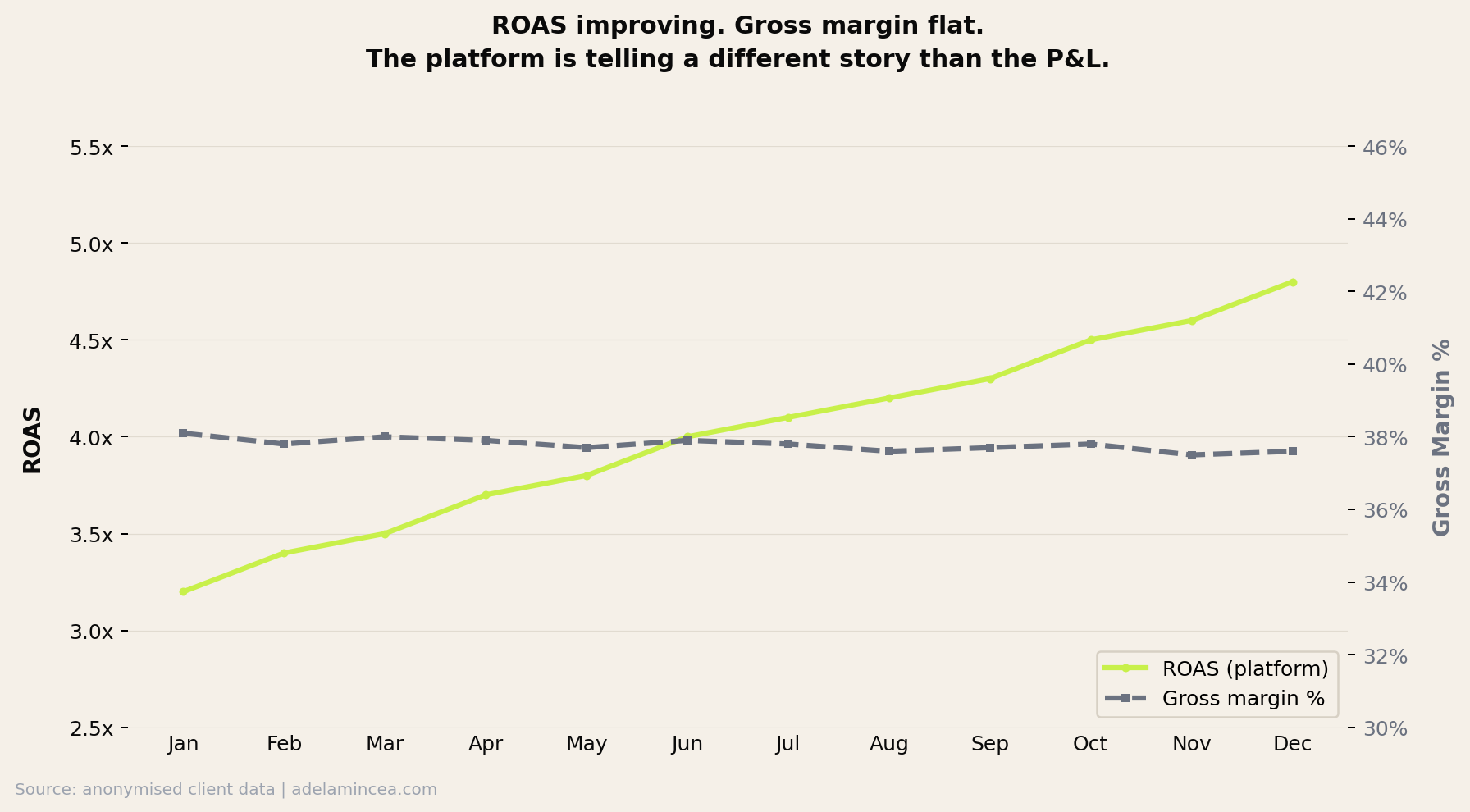
ROAS climbed from 3.2x to 4.8x over 12 months. Gross margin stayed flat at 38%. The platform reported continuous improvement. The P&L told a different story. Source: anonymised client data.
If your ROAS is up but your margin isn't moving, the Digital Economic Review surfaces what the platform isn't showing you.
See what it covers →What an economic analysis actually finds
The client I mentioned at the start had a Google Ads ROAS of 4.1x over twelve months. By any standard benchmark, that reads as healthy.
When I built a channel-by-channel CAC model using their actual revenue and margin data, the picture was different. Their Google Search campaigns had a CAC of $34 against an average order value of $89 and a 38% gross margin. Profitable unit economics. Their Performance Max campaigns had a CAC of $112 for the same customer profile, with most of the attributed conversions coming from branded queries. They were paying $112 to acquire customers who were already going to buy.
The blended ROAS hid this entirely. The 4.1x was an average that masked a 9x in Search and a 1.8x in PMax. Budget was being allocated based on the blended number, which meant the 1.8x grew proportionally alongside the 9x.
No platform report surfaced this. It required pulling revenue by campaign type, stripping branded traffic, calculating CAC against actual margin, and building the economic model the platform does not build for you.
That is what a marketing economics analysis produces. Not campaign optimization. Economic analysis of what the acquisition model is actually doing.
When a business needs this function
There is a point in a business's growth where the economic analysis of the acquisition model stops being optional. The signals are consistent enough that I can describe them.
Revenue is growing but margin is flat or declining. The business is acquiring customers, but each one costs more to acquire than the model assumed when the business was smaller. This is a unit economics problem, not a campaign problem.
Spend is increasing but results are not scaling proportionally. The first $10,000 in paid media produced a certain CAC. The next $10,000 produced a higher one. Diminishing returns appears in almost every acquisition model at some spend level. Recognizing where that inflection point is, before you reach it, is an economic question.
Platform metrics and business results are telling different stories. The dashboard is green. The P&L is under pressure. The gap between them is a measurement problem: you are measuring the wrong thing, not the right thing badly.
You are about to significantly increase spend. Before you scale a model, you need to know whether it holds at higher volumes. Most acquisition models don't, in their current form, without changes. The economic analysis should precede the budget decision.
If any of these describe your situation, you have a marketing economics problem. Campaign optimization won't fix it, because the problem is not in the campaigns.
What the function covers
In practice, a marketing economics analysis covers four things.
Customer acquisition cost by channel. Not blended. Not averaged. Broken down by source, campaign type, and product category, against actual margin data. This is the number that determines whether the business can scale the model or not.
Attribution quality. Whether the model you're using to attribute conversions reflects what's actually driving them, or whether your budget decisions are based on platform data that doesn't represent commercial reality.
ROAS stability. Whether your headline numbers hold across time periods, spend levels, and segments, or whether they're averages that hide structural problems in specific campaign types or channels.
Scaling verdict. Whether the economics support increasing spend, and if not, what needs to change first. A direct answer to the question most marketing reports are never asked to answer.
These four outputs tell you what your acquisition model is doing. They do not tell you how to adjust a bid strategy or which keyword to pause. They tell you whether the model you're running can sustainably acquire customers at the economics your business requires.
The function most businesses are missing
The most important question about your marketing investment is not which channel is performing. It is what this investment is doing to the economics of acquiring a customer, and whether you can sustain it at the scale you're planning.
That question sits at the intersection of marketing and economics. Most businesses have people covering one side. Very few have someone covering both.
The term "marketing economist" doesn't appear on most job boards yet, because the discipline hasn't been formalized that way. But the need for the function is structural. The platforms will keep reporting platform performance. Someone needs to report on commercial performance. Those are not the same report, and only one of them tells you whether your marketing investment is actually working.
I came to this from an economics degree first, paid media second. The econometrics and consumer behaviour training gave me the frame. The 13 years managing live accounts gave me the data. The combination is what makes the analysis possible: you need both the model and the numbers to say anything useful.
If you have been running the campaigns and the two stories, platform and P&L, don't match, the answer is probably not in the campaigns.
This applies consistently to businesses spending $3,000 to $50,000 per month across paid channels. At enterprise scale, the structural principles hold and the models become more complex.
The Digital Economic Review is built around exactly this analysis. CAC by channel, attribution quality, ROAS stability, and a scaling verdict. Priced from $999. Delivered in 5 to 7 business days.
This article was originally published in The Marketing Economist newsletter on LinkedIn.
Adela Mincea is a marketing economist, paid media strategist, and certified trainer. She helps growing businesses make marketing profitable before scaling it by validating margins, acquisition economics, and pricing power before deploying paid media and AI-enabled systems.

Adela Mincea
Marketing Economist
The Marketing Economist
One concept from economics. One marketing decision it changes.
One issue per month. Each one takes an economic concept and applies it to a real marketing decision, the kind that affects budget, margin, or growth.